
Mary MacGregor-Reid | Celestial Bodies
15 August - 19 September
Opening 2pm Saturday 15 August
Crystal singing bowl performance by Alchemy Aotearoa
A celestial body is a naturally occurring physical entity, such as a sun, planet, moon, or asteroid that exists in the observable universe. Over the course of human history, there has existed an evolving relationship between us and our most influential celestial bodies; the sun and the moon. They inspire humanity, they impact us by their very existence, but still, historically in myth and story, we have given them extra power by imbuing them with personality, motive and even deification.
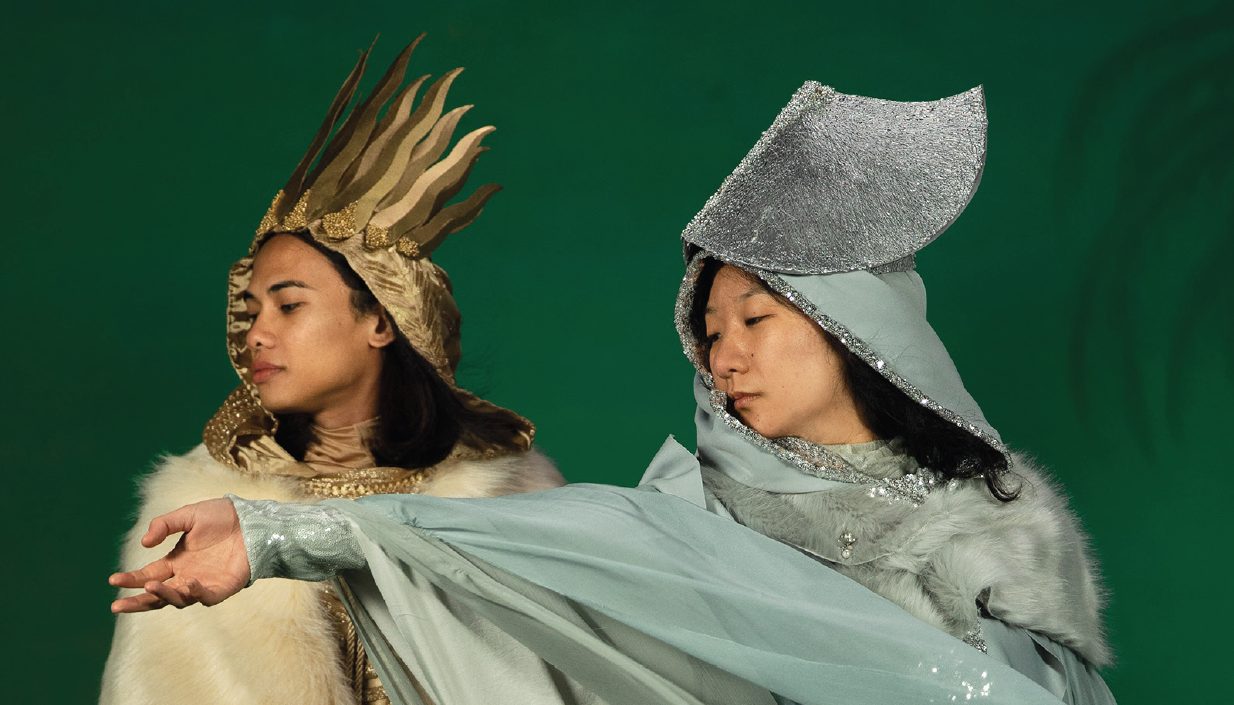
In the case of this work, Sol and Luna allow us to see them in their humanised forms as they travel their intersecting paths across an idyllically scenic yet brooding realm. Sun and moon, gold and silver, pass across the sky meeting once to ‘touch’ in an eclipse redolent of ‘conjunctio’, the alchemical marriage. While we are watching them, only once do they turn to face us and acknowledge our gaze, but even then they look through and beyond us, as if our existence doesn’t touch them at all.
The exhibition presents a nine‑channel video across three screens where Sol and Luna move and intersect creating a looping narrative reflecting the recurring movement of the celestial bodies. The work positions celestial mythology within a contemporary visual framework, highlighting how ancient narratives persist in modern visual culture.
Ko tētahi o te whānau mārama he hanga kikokiko ka puta māori noa pērā i te rā, te aorangi, te marama, te aorangi iti rānei kei te ao tukupū ka kitea e te karu. Taka iho i ngā hītori mō te tangata, tērā tētahi hononga kuneroa i waenga i a tātou me ērā o te whānau mārama kawenga nui; te rā me te marama. Whakaohooho ana rāua i te tangata, he pāpātanga ō rāua i te iringa noa mai, heoi anō, heke iho i roto i ngā pakiwaitara, he mana nui atu kua uhia ki a rāua i tā tātou whakatō atu i te tuakiri, te kaupapa, tae atu ki te atuatanga.
Ko tētahi o te whānau mārama he hanga kikokiko ka puta māori noa pērā i te rā, te aorangi, te marama, te aorangi iti rānei kei te ao tukupū ka kitea e te karu. Taka iho i ngā hītori mō te tangata, tērā tētahi hononga kuneroa i waenga i a tātou me ērā o te whānau mārama kawenga nui; te rā me te marama. Whakaohooho ana rāua i te tangata, he pāpātanga ō rāua i te iringa noa mai, heoi anō, heke iho i roto i ngā pakiwaitara, he mana nui atu kua uhia ki a rāua i tā tātou whakatō atu i te tuakiri, te kaupapa, tae atu ki te atuatanga.
E tāpaea ana e te whakaaturanga he ataata hongere-iwa rere i ētahi mata e toru, e rere ai, e whakawhiti ai a Rā rāua ko Marama, e tuhia ai he kōrero hurihuri e whakaahua ana i te nekehanga auau a te whānau mārama. E whakanoho mai ana te mahi i te pakiwaitara mō te whānau mārama ki te anga ataata ao hou, e whakamiramirahia ai te āhua o te kitea tonutia o te kōrero o nehe i te ahurea ataata o te ao hou.
Kuputaka / Glossary
Idyllically scenic yet brooding realm – ao kaurerehu whakapau kanohi
Eclipse – te āraitanga a tētahi i tētahi
Redolent of ‘conjunctio’, the alchemical marriage - me he ‘hononga tapu’
Translation by Te Haumihiata Mason (Licenced Translator)
天体是指存在于可观测宇宙中的自然存在的物理实体,例如太阳、行星、卫星或小行星。在人类历史长河中,我们与对我们影响最大的天体—太阳和月亮—之间存在着不断演变的关系。它们启发着人类,它们的存在本身就影响着我们,但即便如此,在历史上的神话和故事中,我们仍然赋予它们额外的力量,赋予它们个性、动机,甚至神化。 在这件作品中,太阳和月亮以拟人化的形态出现,让我们得以一窥它们在风景如画却又略带忧郁的领域中交错的轨迹。太阳和月亮,金色和银色,划过天空,在日食中相遇,仿佛在暗示着“结合”(conjunctio),炼金术中的结合。当我们注视着它们时,它们只转过身来面对我们,回应我们的目光,但即便如此,它们的目光也穿透了我们,超越了我们,仿佛我们的存在根本无法触及它们。 展览呈现了一部横跨三块屏幕的九频道视频,其中太阳和月亮不断移动交错,构成循环往复的叙事,反映了天体的周期性运动。该作品将天体神话置于当代视觉框架之中,凸显了古老的叙事如何在现代视觉文化中延续。
Translation by Taoran Li and Aria Zhang
About the Artist:
Mary works primarily with photography and moving image, though much of her practice unfolds long before the camera is introduced. She constructs the objects, props, and sculptural elements that appear within her works, treating the set not as a backdrop but as an extension of the final image.
Her work draws on symbolic traditions, particularly alchemy, which employed coded imagery to describe processes of transformation. The use of archetypal figures, gesture, costume, and symbolic objects is central to many esoteric rituals, and these visual languages inform her practice. Her work sits within a renewed contemporary interest in early twentieth-century artists—particularly women—who incorporated esoteric ideas into their creative vocabulary. She is interested in how these artists used ritual and symbolism to articulate forms of knowledge that exist beyond the rational or everyday.
Across moving image, sculpture, and installation, Mary explores how gestures, atmospheres, and symbolic residues persist across time. Through slow motion, light, and carefully considered material surfaces, she creates works that unfold at a contemplative pace, suspended between stillness and transformation, inviting viewers into spaces that feel both familiar and otherworldly.